
Peptides-
What are they and what are they good for?

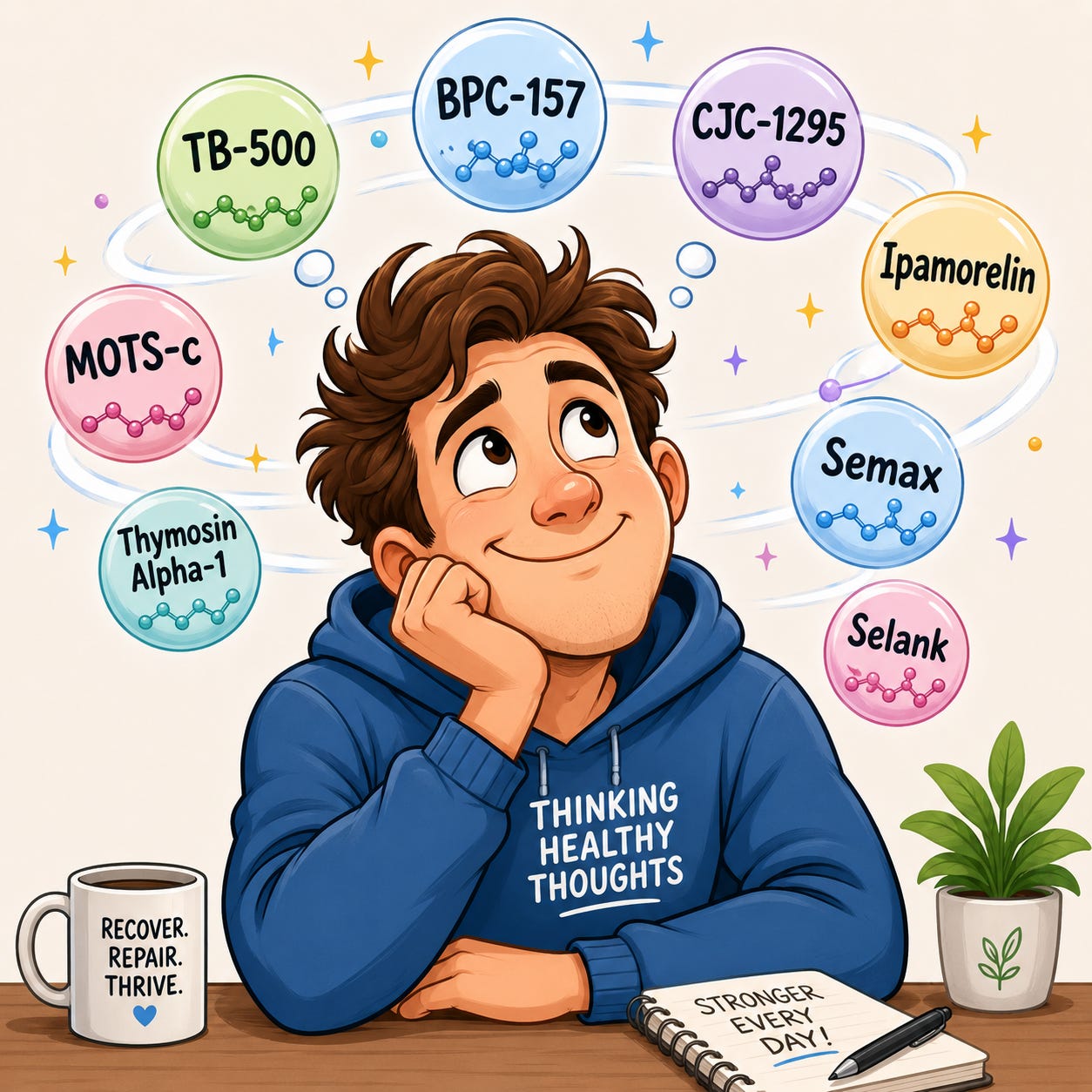
With the GLP-1’s grabbing everybody’s attention nationwide, I have noticed that more and more people are asking me about peptides and what they are and what they’re good for. I recently saw a fantastic video by Ashley Froese where she puts peptides into several simple categories as to what they do and how they work. I want to share that knowledge with you now ( and refer you back to her video and her other peptide articles and work) and hopefully I can answer most of the questions that you have about peptides, as they are an exploding area of medical practice these days.
Who Is Dr. Ashley Froese?
Dr. Ashley Froese is a board-certified family medicine physician who recognized that the world of peptides was drowning in confusion — overhyped by biohackers, undersupported by mainstream medicine, and nearly impossible for the average person to navigate. Her mission: cut through the noise with real, medically grounded education so people can make informed decisions with confidence.
Her YouTube channel, This Is Not Covered, has become a go-to resource for anyone trying to understand peptide therapy without the bro-science. Her crash course video, “Learn Peptides So Fast it’s UNREAL,” organizes the entire peptide landscape into 7 clear “buckets” — a framework she calls the “Fascinated Biology” Peptide Lineup.
The Big Idea: Peptides as Cellular Text Messages
Before diving into the buckets, Dr. Froese establishes a foundational concept that reframes how we think about these compounds.
Traditional medications work by overriding your biology — suppressing a symptom, blocking a receptor, forcing a chemical change. Peptides work differently. As short chains of amino acids, they function like specific text messages between cells, fitting into cellular receptors like keys into locks to tell the body what to do: repair tissue, burn fat, build muscle, calm inflammation, sleep deeper.
This is not just a clever metaphor. It reflects a genuine mechanistic difference. Rather than patching over dysfunction, peptides aim to restore the body’s own signaling pathways — the internal “software” that manages healing, energy, and recovery. That’s why Dr. Froese frames them as representing a shift in medicine: from symptom management toward root-cause biological optimization.
Two organs she highlights as central to understanding peptides:
The mitochondria — the cellular “batteries” that power everything from recovery to cognitive function. Their decline with age underlies chronic fatigue, weight gain, and poor sleep.
The pituitary gland — the master regulator of growth hormone, which controls body composition, tissue repair, and metabolic rate.
With that foundation in place, here are the 7 buckets.
Bucket 1: Inflammation & Repair
Key peptides: BPC-157, TB-500, GHK-Cu, KPV
This is the bucket with the strongest and most accessible evidence base, and it’s where Dr. Froese typically starts with patients.
BPC-157
Body Protection Compound 157 is a fragment of a peptide naturally found in gastric juice. Its primary mechanisms include promoting angiogenesis (new blood vessel growth), stimulating collagen production, and accelerating the healing of gut lining, tendons, ligaments, and muscle tissue.
Dr. Froese considers BPC-157 the peptide she is most comfortable discussing clinically. The animal data is extensive, the proposed mechanisms are biologically sound, and anecdotal human reports are consistently positive. The main caveat: randomized controlled human trials are still largely absent. She recommends it most confidently for gut issues (where oral administration delivers the peptide directly to the target tissue) and for soft tissue injuries that haven’t responded to conventional care.
TB-500 (Thymosin Beta-4)
TB-500 is a synthetic version of Thymosin Beta-4, a naturally occurring protein that promotes cell migration, angiogenesis, and tissue remodeling. Its research history is longer than BPC-157’s, with studies in wound healing, cardiac repair, and corneal injury going back decades.
The combination of BPC-157 + TB-500, sometimes called the “Wolverine Stack,” is popular in the athletic community. The rationale is logical — their mechanisms are complementary, with BPC-157 promoting blood flow and collagen and TB-500 facilitating cellular reorganization. The two together act, as Dr. Froese puts it, like a “construction crew” for the body. The combination has not been studied in controlled trials, but the individual evidence bases for each are the strongest among non-FDA-approved peptides.
GHK-Cu (Copper Peptide)
GHK-Cu is a copper-binding tripeptide naturally found in human plasma. It signals cells to rebuild and regenerate, with applications in skin health (collagen stimulation, wound healing) and hair follicle growth. In cosmetic contexts, it’s one of the most research-backed topical peptides available — a legitimate “cellular tune-up” rather than a gimmick.
KPV
KPV is a tripeptide fragment of alpha-Melanocyte Stimulating Hormone (alpha-MSH). It suppresses inflammation at the cellular and gut level, effectively helping flip the body from “defense mode” into “repair and recovery mode.” Research is promising, particularly for inflammatory bowel conditions, but it is earlier-stage than BPC-157. Dr. Froese rates it as having genuine potential but needing more evidence before confident clinical recommendations.
Bucket 2: Mitochondrial Energy
Key peptides: SS-31, MOTS-c
This bucket addresses one of the root causes of aging and chronic illness: mitochondrial decline. As we age, our mitochondria produce less energy, become more vulnerable to oxidative stress, and lose efficiency. The downstream effects are profound — fatigue, difficulty losing weight, poor sleep, cognitive fog, and slower recovery.
MOTS-c
MOTS-c is a peptide encoded in mitochondrial DNA itself — a discovery that was considered remarkable when it was identified. It acts as a metabolic signal, telling the body to create more mitochondria and burn fatty acids more efficiently. It has been studied for its role in insulin sensitivity, exercise performance, and metabolic regulation. Think of it as a signal that says: make more batteries and use them better.
SS-31
SS-31 (elamipretide) takes a different approach — rather than creating new mitochondria, it stabilizes the ones you already have. It targets the inner mitochondrial membrane, reducing oxidative stress and supporting efficient energy production. It has been studied clinically for heart failure, kidney disease, and primary mitochondrial disorders — making it one of the more clinically investigated peptides on this list.
Dr. Froese notes that combining these peptides with lifestyle practices like intermittent fasting and cold exposure can amplify their effects, as those habits independently signal the body to optimize its energy systems.
Bucket 3: Physique & Recovery
Key peptides: Ipamorelin, CJC-1295, Tesamorelin, GHRP-2/GHRP-6, IGF-1 LR3, Follistatin
This bucket covers growth hormone secretagogues and related compounds — peptides that influence the body’s natural production of growth hormone and its downstream effects on muscle, fat, and recovery.
Ipamorelin
Ipamorelin works by mimicking ghrelin, the hunger hormone, to stimulate the pituitary gland to release growth hormone. Unlike direct GH injection, it works through the body’s own feedback loop, producing a more physiological pattern of release. It is selective — it does not significantly raise hunger or cortisol alongside GH.
Dr. Froese rates it as lower priority compared to Bucket 1 peptides. The GH increases are modest, and whether they translate to clinically meaningful improvements in sleep, body composition, and recovery is debatable for people with normal GH levels. That said, she has patients who report clear benefits, particularly around sleep quality.
CJC-1295
Often stacked with Ipamorelin, CJC-1295 extends the duration of growth hormone release. The version with DAC (drug affinity complex) has a multi-day half-life, producing sustained GH elevation. Dr. Froese is more cautious here — the sustained elevation is less physiological and carries more potential for side effects like water retention, joint discomfort, and blood sugar changes.
Tesamorelin
Tesamorelin is a growth hormone-releasing hormone (GHRH) analogue with an important distinction: it is FDA-approved, specifically for reducing visceral fat in HIV-associated lipodystrophy. Its ability to target fat around organs makes it one of the more compelling body composition peptides with actual regulatory backing.
GHRP-2 / GHRP-6
These growth hormone-releasing peptides stimulate the pituitary directly. GHRP-6 is known for also increasing appetite (via ghrelin stimulation), which can be a benefit or a drawback depending on the individual’s goals.
IGF-1 LR3
A long-acting version of Insulin-like Growth Factor-1, IGF-1 LR3 promotes systemic muscle growth and recovery. It is a downstream mediator of growth hormone’s anabolic effects. More potent, and accordingly carries more risk if misused.
Follistatin
Promotes muscle hypertrophy by inhibiting myostatin — the protein that normally limits how much muscle the body can build. A compound of significant interest in research, though clinical evidence in humans remains limited.
Bucket 4: The GLP-1 Revolution
Key peptides: Semaglutide, Tirzepatide, Retatrutide, Cagrilintide, 5-Amino-1MQ
This is arguably the most culturally significant bucket right now. GLP-1 receptor agonists have transformed metabolic medicine, and Dr. Froese positions them squarely within the peptide framework.
Semaglutide & Tirzepatide
These medications mimic natural gut hormones (GLP-1, and in tirzepatide’s case, also GIP) to restore metabolic rhythms. They communicate directly with the brain and pancreas to reduce appetite, improve insulin sensitivity, and regulate energy storage. Dr. Froese frames insulin resistance as the root cause of obesity and much chronic disease — and these peptides as a “total system reboot” of the body’s metabolic software.
They are not just weight loss drugs. They address the underlying hormonal miscommunication that drives fat storage and hunger dysregulation in the first place.
Retatrutide
A newer triple agonist (GLP-1, GIP, and glucagon receptors), retatrutide represents the next generation of metabolic peptides, with early trials showing even more substantial effects on weight and metabolic markers.
Cagrilintide
An amylin analogue that works alongside GLP-1 pathways to further regulate appetite and blood sugar, often studied in combination with semaglutide.
5-Amino-1MQ
A non-peptide small molecule worth noting here: it increases NAD+ levels and insulin sensitivity by blocking an enzyme that slows metabolism. Dr. Froese mentions it as a complementary tool in the metabolic optimization space.
Bucket 5: Cognitive Focus
Key peptides: Semax, Dihexa
Dr. Froese approaches this bucket with both enthusiasm for the potential and appropriate caution about the evidence and risks.
Semax
A synthetic fragment of ACTH (adrenocorticotropic hormone), Semax influences dopamine and serotonin systems to improve focus, memory, and mental clarity. It has been studied in Russia for decades for stroke recovery and cognitive enhancement. Dr. Froese highlights its potential while noting the research base is largely outside Western clinical trial frameworks.
Dihexa
One of the more potent nootropic peptides in discussion, Dihexa has been studied for its ability to form new neural connections — a process called synaptogenesis. It has shown promise in animal models of Alzheimer’s disease and cognitive decline. Dr. Froese flags it as genuinely interesting but notes the human evidence is thin and the potency warrants respect.
The broader vision she articulates: a future where medicine helps the brain repair its own communication pathways rather than simply masking cognitive decline with symptom-management drugs.
Bucket 6: Anxiety & Stress
Key peptide: Selank
Selank
Selank is a synthetic peptide analogue of tuftsin, an immune-modulating peptide, with significant anxiolytic (anti-anxiety) properties. It modulates the GABA system and influences serotonin, dopamine, and brain-derived neurotrophic factor (BDNF) levels.
Dr. Froese presents Selank as a “calming the system” peptide — one that helps regulate the stress response without the sedation or dependence risks associated with benzodiazepines. It has been studied in Russia and Eastern Europe for anxiety, depression, and stress-related conditions. The evidence is promising, though largely from non-Western sources, and human clinical trials in Western settings remain limited.
Bucket 7: Sleep & Longevity
Key peptides: Epithalon (Epitalon), DSIP, Thymosin Alpha-1, FOXO4-DRI
This bucket represents perhaps the most forward-looking area of peptide research — compounds aimed not just at fixing what’s broken, but at extending healthspan and slowing the biological clock.
Epithalon (Epitalon)
A tetrapeptide derived from the pineal gland, Epithalon is one of the most studied longevity peptides. It has been researched for its ability to regulate circadian rhythms, support melatonin production, and — most intriguingly — potentially lengthen telomeres, the protective caps on chromosomes that shorten with age. Telomere length is one of the most studied biomarkers of biological aging. Dr. Froese frames Epithalon as a “direct anti-aging signal” at the cellular level.
DSIP (Delta Sleep-Inducing Peptide)
As the name suggests, DSIP was identified for its role in promoting slow-wave (deep) sleep. It also appears to influence stress hormones and has been studied for its role in regulating the body’s overall stress-recovery balance. For people struggling with sleep architecture, particularly reduced deep sleep, DSIP is an area of growing interest.
Thymosin Alpha-1
An immune-modulating peptide that strengthens and coordinates the immune system’s response. Rather than stimulating an already overactive immune system, it helps the immune system become more precise and effective. It has been studied for viral infections, cancer adjunct therapy, and immune dysregulation.
FOXO4-DRI
A senolytic peptide — one that targets senescent cells. Senescent cells are damaged, dysfunctional cells that should die off through apoptosis (programmed cell death) but instead linger in tissue, secreting inflammatory signals that accelerate aging and disease. Dr. Froese describes this process as “cellular housekeeping” — clearing out the biological clutter that accumulates over a lifetime. This is not just anti-aging in the cosmetic sense; it represents a fundamental approach to maintaining cellular integrity.
Dr. Froese’s Honest Scorecard: Hype vs. Healing
One of the most valuable aspects of Dr. Froese’s work is her refusal to treat peptides as a monolithic category. In her “Hype or Healing?” evaluation, she rates each compound on its actual evidence:
PeptideVerdict Key Reason
BPC-157Healing (with caveats)Extensive preclinical data, strong anecdotal support, oral route logic
TB-500Healing (with caveats)Decades of mechanistic research, strong complement to BPC-157
TesamorelinHealingFDA-approved for visceral fat reduction
PT-141 (Bremelanotide)Healing for specific useFDA-approved as Vyleesi for HSDD in women
EpithalonPromisingTelomere and circadian rhythm research compelling
MOTS-c / SS-31PromisingStrong mechanistic logic, growing research
baseIpamorelinModerateModest GH increases; meaningful for some, debatable for many
CJC-1295CautionLess physiological GH pattern, more side effect reports
DihexaCautionPotent but thin human evidence
KPVToo earlyInteresting, not yet evidence-based for confident recommendation
The Takeaway: A Framework, Not a Shopping List
Dr. Froese’s most important message is this: peptides are not a category — they are a collection of individual compounds, each with its own mechanism, evidence base, risk profile, and appropriate use case. Treating them as interchangeable, or assuming that because BPC-157 is well-supported then Dihexa must be too, is exactly the kind of reasoning she’s working to correct.
Her 7-bucket framework gives you a mental model:
Inflammation & Repair — fix what’s broken (strongest evidence)
Mitochondrial Energy — repower your cells
Physique & Recovery — optimize body composition and healing
GLP-1 / Metabolic — reboot metabolic software
Cognitive Focus — enhance neural performance (promising, proceed with care)
Anxiety & Stress — calm the system
Sleep & Longevity — reset the clock, extend healthspan
Start with the bucket most relevant to your goals. Start with the peptides that have the deepest evidence. Work with a knowledgeable physician. And stop spending money on peptides you don’t understand.
Dr. Ashley Froese offers a full Peptide Mastery Course at courses.drafroese.com for those who want to go deeper than a YouTube video. She is not your physician — so I recommend that you always consult a healthcare professional before starting any peptide protocol.